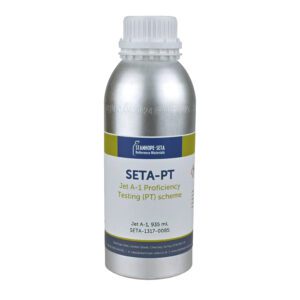
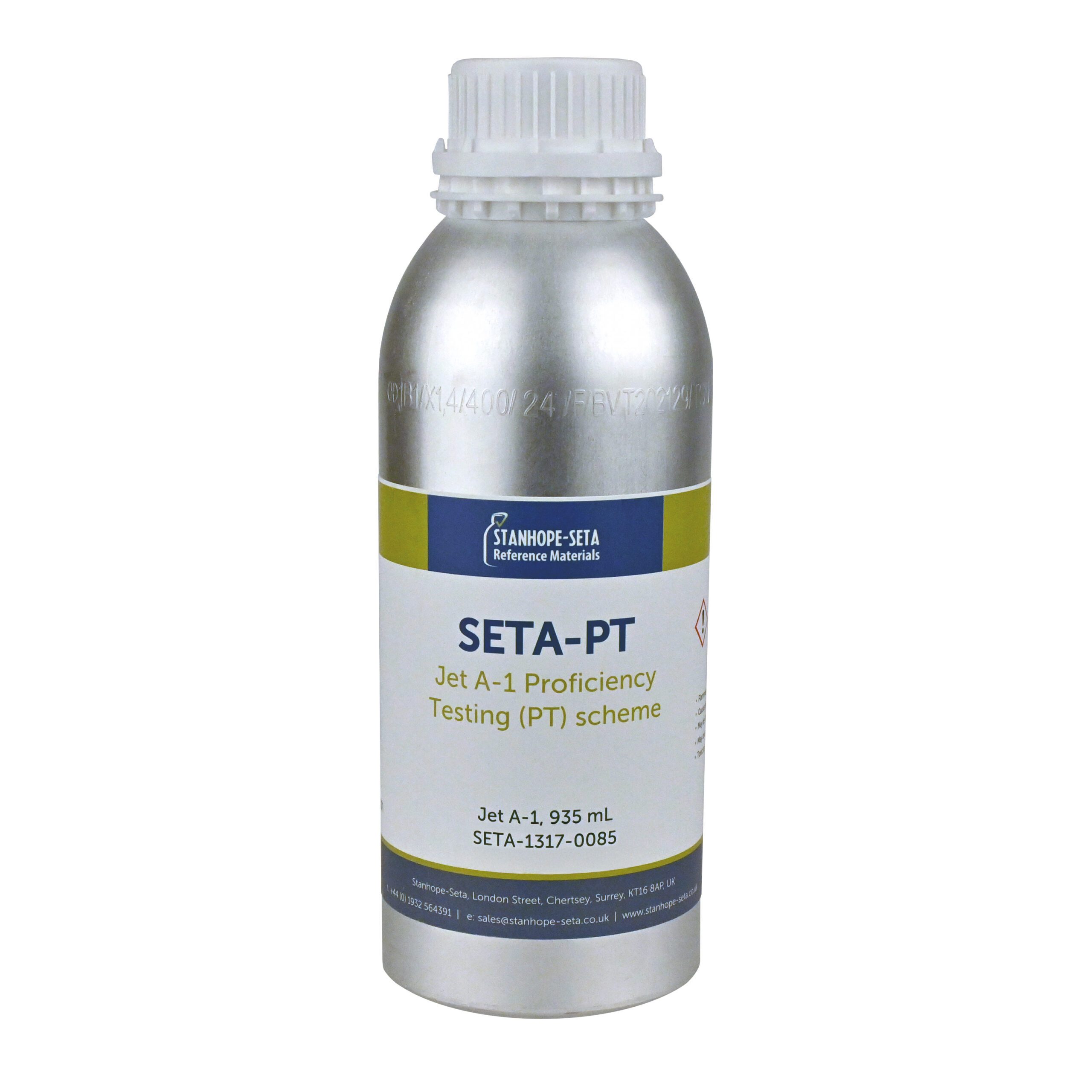
Jet A-1 Proficiency Test Scheme
Part number SETA-1317-0085
The Jet A-1 Proficiency Test (PT) Scheme helps laboratories demonstrate ongoing competence and support accreditation by comparing results against a global participant base, aligned with test methods used in Defence Standard 91-091 and ASTM D1655.
Frequency: Bi-annual (two rounds per year).
Sample source: Jet A-1 fuel sourced from a supply network serving UK airports and terminals, providing a true representation of Jet A-1.
| Part Number: | SETA-1317-0085 |
|---|---|
| Methods: | ASTM D130, ASTM D1319, ASTM D1322, ASTM D156, ASTM D1840, ASTM D2386, ASTM D2624, ASTM D3227, ASTM D3241, ASTM D3242, ASTM D3948, ASTM D4052, ASTM D445, ASTM D5001, ASTM D5452, ASTM D56, ASTM D6045, ASTM D6379, ASTM D7797, ASTM D8073, ASTM D86, ASTM D93, IP 123, IP 154, IP 156, IP 16, IP 170, IP 274, IP 30, IP 323, IP 336, IP 342, IP 354, IP 365, IP 423, IP 436, IP 540, IP 565, IP 577, IP 583, IP 598, IP 624, IP 71 |
What you’ll receive
Each participating laboratory receives a detailed report including:
Statistical processing: Results are processed using statistical procedures in BS EN ISO 4259-1 & 4259-3. Data is pre-screened using GESD in accordance with ISO 4259-1; any outliers removed after review are clearly indicated and excluded from the dataset.
Sample handling and integrity: All operations are carried out at Stanhope-Seta’s ISO 17025 & ISO 17034 accredited Richardson Laboratory.
| Method | Details |
|---|---|
| ASTM D130 | Standard Test Method for Corrosiveness to Copper from Petroleum Products by Copper Strip Test |
| ASTM D1319 | Standard Test Method for Hydrocarbon Types in Liquid Petroleum Products by Fluorescent Indicator Adsorption |
| ASTM D1322 | Standard Test Method for Smoke Point of Kerosine and Aviation Turbine Fuel |
| ASTM D156 | Standard Test Method for Saybolt Colour of Petroleum Products (Saybolt Chrometer Method) |
| ASTM D1840 | Standard Test Method for Naphthalene Hydrocarbons in Aviation Turbine Fuels by Ultraviolet Spectrophotometry |
| ASTM D2386 | Standard Test Method for Freezing Point of Aviation Fuels |
| ASTM D2624 | Standard Test Methods for Electrical Conductivity of Aviation and Distillate Fuels |
| ASTM D3227 | Standard Test Method for (Thiol Mercaptan) Sulfur in Gasoline, Kerosine, Aviation Turbine, and Distillate Fuels (Potentiometric Method) |
| ASTM D3241 | Standard Test Method for Thermal Oxidation Stability of Aviation Turbine Fuels |
| ASTM D3242 | Standard Test Method for Acidity in Aviation Turbine Fuel |
| ASTM D3948 | Standard Test Method for Determining Water Separation Characteristics of Aviation Turbine Fuels by Portable Separometer |
| ASTM D4052 | Standard Test Method for Density, Relative Density, and API Gravity of Liquids by Digital Density Meter |
| ASTM D445 | Standard Test Method for Kinematic Viscosity of Transparent and Opaque Liquids (and Calculation of Dynamic Viscosity) |
| ASTM D5001 | Standard Test Method for Measurement of Lubricity of Aviation Turbine Fuels by the Ball-on-Cylinder Lubricity Evaluator (BOCLE) |
| ASTM D5452 | Standard Test Method for Particulate Contamination in Aviation Fuels by Laboratory Filtration |
| ASTM D56 | Standard Test Method for Flash Point by Tag Closed Cup Tester |
| ASTM D6045 | Standard Test Method for Color of Petroleum Products by the Automatic Tristimulus Method |
| ASTM D6379 | Standard Test Method for Determination of Aromatic Hydrocarbon Types in Aviation Fuels and Petroleum Distillates—High Performance Liquid Chromatography Method with Refractive Index Detection |
| ASTM D7797 | Standard Test Method for Determination of the Fatty Acid Methyl Esters Content of Aviation Turbine Fuel Using Flow Analysis by Fourier Transform Infrared Spectroscopy—Rapid Screening Method |
| ASTM D8073 | Standard Test Method for Determination of Water Separation Characteristics of Aviation Turbine Fuel by Small Scale Water Separation Instrument |
| ASTM D86 | Standard Test Method for Distillation of Petroleum Products at Atmospheric Pressure |
| ASTM D93 | Standard Test Methods for Flash Point by Pensky-Martens Closed Cup Tester |
| IP 123 | Petroleum products - Determination of distillation characteristics at atmospheric pressure (ISO 3405:2000) |
| IP 154 | Petroleum products - Corrosiveness to copper - Copper strip test |
| IP 156 | Determination of hydrocarbon types in petroleum products - Fluorescent indicator adsorption method |
| IP 16 | Determination of the freezing point of aviation fuels - Manual method |
| IP 170 | Petroleum products and other liquids - Determination of flash point - Abel closed cup method (ISO 13736:1997) |
| IP 274 | Determination of electrical conductivity of aviation and distillate fuels |
| IP 30 | Detection of mercaptans, hydrogen sulfide, elemental sulfur and peroxides - Doctor test method |
| IP 323 | Determination of thermal oxidation stability of gas turbine fuels |
| IP 336 | Petroleum products - Determination of sulfur content - Energy-dispersive-X-ray fluorescence method |
| IP 342 | Petroleum products - Determination of thiol (mercaptan) sulfur in light and middle distillate fuels -Potentiometric method |
| IP 354 | Determination of the acid number of aviation turbine fuels - Colour-indicator titration method |
| IP 365 | Density and Relative Density of Liquids by Digital Density Meter |
| IP 423 | Determination of particulate contaminant in aviation turbine fuels by laboratory filtration |
| IP 436 | Determination of aromatic hydrocarbon in aviation fuels & petroleum distillates - High performance liquid chromatography method |
| IP 540 | Determination of the existent gum content of aviation turbine fuel - Jet evaporation method |
| IP 565 | Determination of the level of cleanliness of aviation turbine fuels – portable automatic particle counter method |
| IP 577 | Determination of the level of cleanliness of aviation turbine fuel - automatic particle counter method using light extinction |
| IP 583 | Rapid Screening Test for FAME in JET |
| IP 598 | Petroleum Products - Determination of the smoke point of kerosine, manual and automated method |
| IP 624 | Determination of water separation characteristics of aviation turbine fuel by small scale water separation instrument |
| IP 71 | Determination of kinematic viscosity |
| Part number | Hazards | Download Documents |
|---|---|---|
| SETA-1317-0085 | N/A |
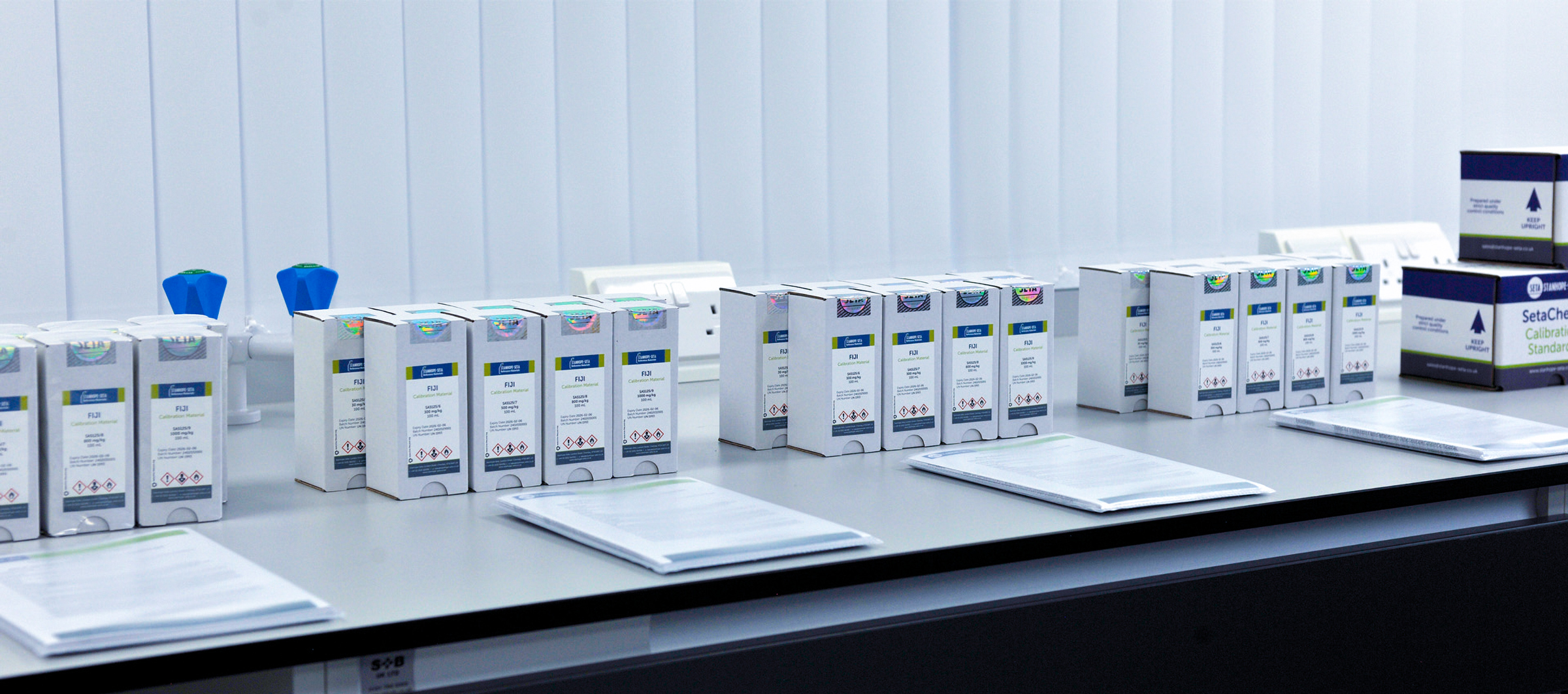
Stanhope-Seta provide direct support by phone and email.
Please contact us for help with setting up your online account or understanding our product range.